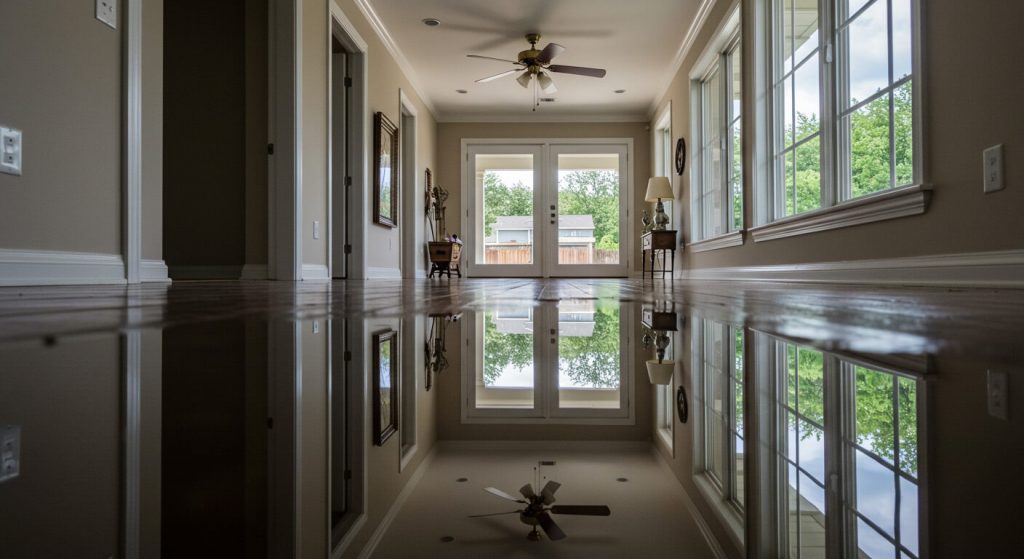
It is the phone call every strata manager dreads on a Friday afternoon. A tenant in a high-rise complex reports water dripping through their ceiling. The water is spreading, the carpet is getting saturated, and the lot owner above insists their plumbing is fine.
For the tenant, this is an emergency. But for the strata manager, the insurance broker and the claims adjuster, it is a complex liability puzzle. The immediate question is not just how to stop the water, but who is responsible?
Is this a body corporate maintenance issue? Is it a lot owner’s liability? Or is it a strata insurance claim process for water damage?In Queensland, the answer is rarely simple. It relies on a specific interpretation of the Body Corporate and Community Management Act 1997 (BCCM Act) and the format plan of the subdivision. Getting this wrong at the start does not just delay repairs; it leads to denied claims, scope disputes and significant friction between stakeholders.
The Ambiguity of Queensland Legislation
Determining the correct number of air movers isn’t guesswork; it’s a multi-variable calculation based on the IICRC S500 The core of the dispute often lies in defining “utility infrastructure.” Under the legislation, pipes and cables are generally considered common property, but there are critical exceptions.
Section 20 of the BCCM Act sets out a specific test. Utility infrastructure is considered the lot owner’s responsibility only if it meets all three of these criteria:
- It supplies a utility service to only one lot.
- It is within the boundaries of that lot.
- It is not located within a boundary structure (like a shared wall or slab).
If the pipe fails even one of these tests, it usually remains body corporate water leak common property.
This is where the distinction between a Building Format Plan (BFP) and a Standard Format Plan (SFP) becomes critical. In a BFP, which typically applies to multi-story unit complexes, the boundary is often the centre of the floor, ceiling or wall. If a pipe bursts inside a boundary wall, it is often a body corporate issue. However, if that same pipe bursts under a vanity cabinet within the lot’s airspace, the liability typically shifts to the lot owner.
The Cost of Using Generalist Contractors
The problem for claims managers is that generalist plumbers and restorers are rarely trained in these legislative nuances.
A standard contractor arrives on site with one goal: fix the leak and dry the floor. They rarely document the precise location of the failure relative to the strata boundaries. They might invoice the body corporate for a repair that should have been the lot owner’s cost, or lump maintenance repair costs in with resultant damage restoration costs.
This lack of detail creates a nightmare for the loss adjuster. Without clear evidence of where the leak originated and what specific boundaries were crossed, the insurer cannot accurately determine liability. This leads to complex insurance claims stalling, requests for further information and insurers potentially denying claims due to lack of maintenance or insufficient evidence of a sudden and accidental event.
The Solution: A Partnership Approach to Water Damage
While at TDR, we do not undertake plumbing repair, to resolve strata water leak responsibility QLD disputes efficiently, you need more than a drying company. You need a partner who understands the strata environment.
At Total Disaster Recovery (TDR), we approach every strata water loss as a liability investigation first and a restoration job second.
1. Evidence-Based Documentation
We ensure all findings are meticulously recorded. By utilising moisture mapping and thermal imaging, we document the location of the water source. We integrate on-site observations with reported data to provide a clear record for insurance assessments.
2. Mapping Water Migration
Water travels across boundaries. A leak in Lot 401 might travel through the common property slab and damage the ceiling of Lot 301. Our technicians map this migration path precisely. This data is required for the adjuster to apportion costs correctly between the lot owner’s contents insurance, the lot owner’s liability and the body corporate’s building policy.
3. Separation of Costs
We provide individual, unit-specific reports to ensure complete privacy between owners. Each report clearly separates maintenance costs from resultant damage. This clarity allows claims departments to process the strata insurance claim process for water damage efficiently without having to unpick bundled invoices or cross-reference multiple properties.
4. Evidence-Based Reporting
Our reports are built for insurers. They include photographic evidence, moisture readings and clear causation statements that align with IICRC S500 standards. This leaves no room for ambiguity the scope of works.
Control the Claim from Day One
In the complex world of strata, ambiguity is expensive. It causes delays, inflates costs and damages relationships between owners and the body corporate.
Do not leave liability to chance. Partner with a specialist who understands the legislation as well as the restoration, so that costs are clear and the correct licensed professionals are doing the correct jobs.
Don’t let strata ambiguity delay your claim. Get a definitive report. Contact TDR for expert restoration of your next strata water loss.